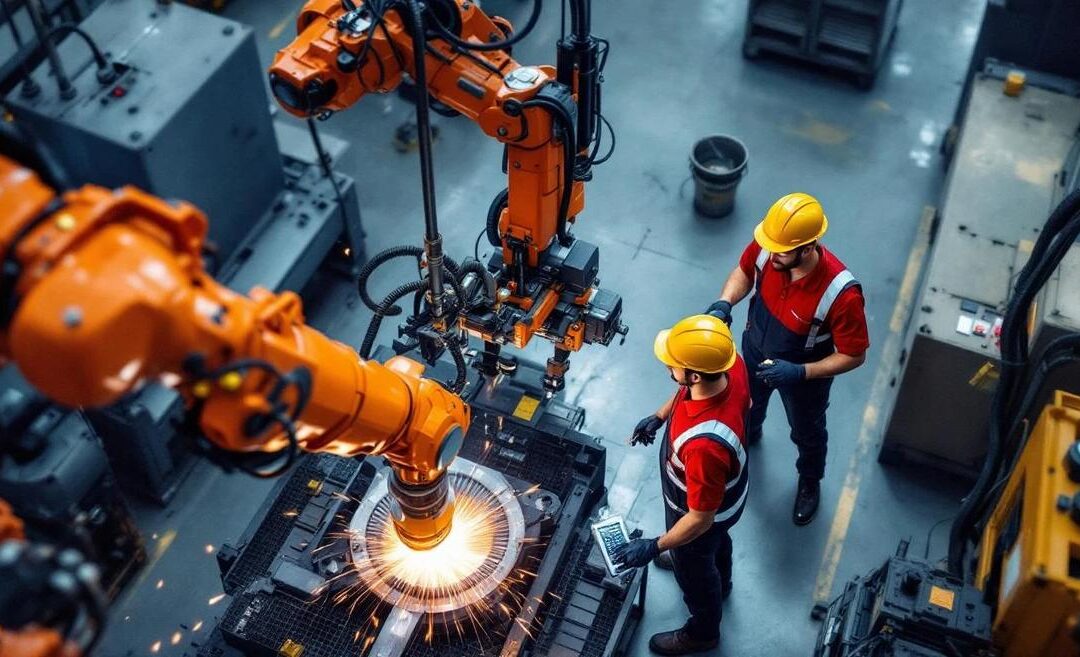
Unsupervised production represents the culmination of industrial automation. Machines that run at night and at weekends, with no human presence. The promise of lights-out manufacturing is seductive because of its productivity gains. But how do you maintain OEE when no...
The frequency of OEE monitoring directly determines your ability to react to production problems. Monitoring that’s too far apart lets losses slip away. Too much monitoring drowns teams in data. In this article, we analyze the three main approaches: daily...
A well-designed OEE dashboard transforms raw data into immediate decisions. But most industrial management dashboards fail not because of a lack of data, but because of an excess of useless information. In this article, we explore the design of the ideal OEE...
In today's industrial environment, integrating cyber-physical systems into production lines represents a real opportunity to improve overall equipment effectiveness (OEE). However, fully exploiting these technologies remains a challenge for many factories. Manual...
In today's industrial environment, Overall Equipment Effectiveness (OEE) is a key indicator for measuring the operational efficiency of factories. However, despite its popularity, its implementation and optimization remain a challenge for many. The traditional...
In an industrial context where operational efficiency and sustainability are becoming imperatives, the concept of the circular economy takes on its full meaning. The key role of Overall Equipment Effectiveness (OEE) in this transition cannot be underestimated....
We put a TeepTrak engineer on one of your lines, instrument it, and measure it with your team. A signed baseline, a weekly review, a decision date set up front. The commitment isn't to buy. It's to measure.
700+ factories · 30+ countries · 4.7/5 on G2 & Capterra