
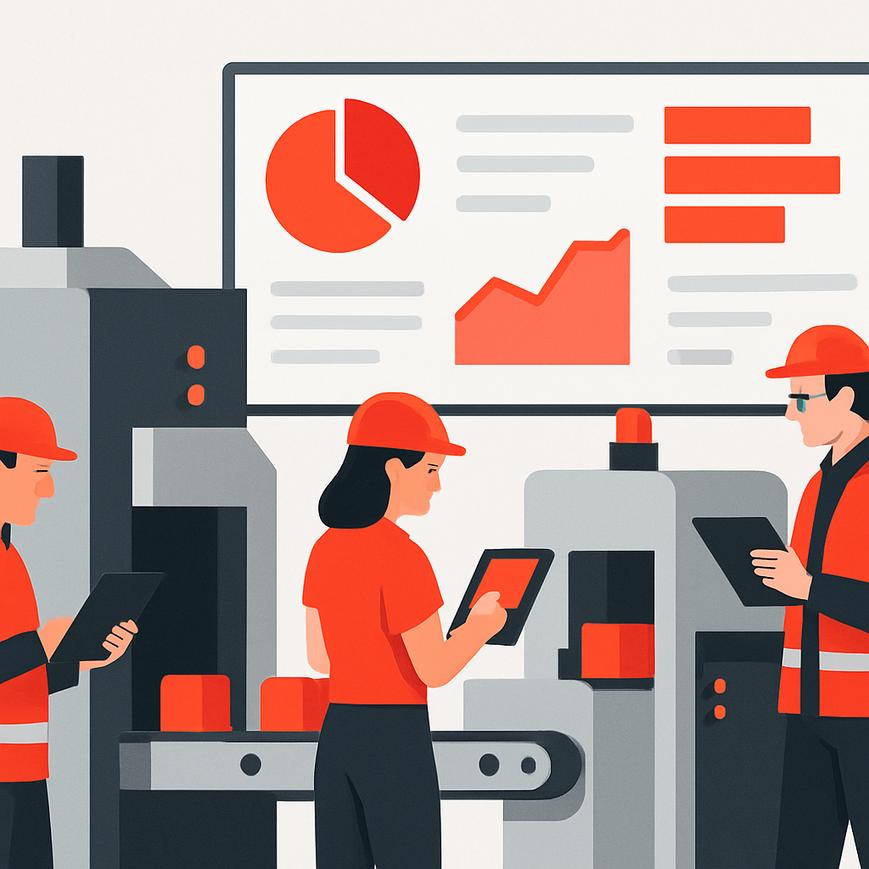
In the process industry, Overall Equipment Effectiveness (OEE) is a crucial indicator for assessing and improving production line performance. OEE measures the efficient use of equipment, combining availability, performance and quality. However, many plants struggle to achieve optimum performance levels, partly due to a poor understanding of the indicators and the absence of a digitalization strategy. Mastering OEE is essential to avoid significant production losses and maintain a competitive edge in the marketplace.
The main obstacles to improving OEE include unplanned machine stoppages, inefficient set-ups and poor product quality. These problems lead to increased downtime and lower productivity, directly impacting production costs and profit margins. Without an accurate analysis of the underlying causes of these inefficiencies, plants continue to suffer performance losses.
To overcome these challenges, plants can adopt a strategy based on continuous improvement and the digitization of production. The use of solutions such as those offered by
One chemical manufacturer recently implemented such a program. By analyzing the data collected by TEEPTRAK, it was able to identify a significant loss of time during batch changes. By realigning processes and applying a Lean methodology, the plant achieved a 15% increase in OEE in six months, reducing production costs and improving customer satisfaction through consistent quality.
For plants seeking to improve their OEE, the first step is to identify critical areas of lost time and efficiency. By combining these observations with a real-time monitoring solution such as
FAQ
Question 1: How does OEE influence industrial performance?
OEE has a direct impact on industrial performance by measuring equipment efficiency. A high OEE indicates optimum machine utilization, which translates into higher productivity and lower costs.
Question 2: Where do I start to improve OEE in my plant?
Start by identifying the main sources of lost performance, such as downtime and production inefficiencies. Using a real-time tracking solution can help you analyze and address these issues effectively.
Question 3: What role does digitalization play in OEE optimization?
Digitization enables real-time monitoring of production data, providing greater visibility of equipment performance. This facilitates targeted interventions to quickly resolve problems and optimize OEE.
0 Comments