

In today’s industrial context, Overall Equipment Effectiveness (OEE) is a key indicator for assessing the competitiveness of production facilities. All too often, plants neglect accurate OEE calculations, compromising their ability to identify opportunities for improvement. Lack of precision in these calculations can lead to underestimation of inefficiencies and potential waste on production lines. OEE calculations are essential for decision-makers who need to continually optimize their resources to sustain profitability and reduce operational costs.
OEE problems often stem from multiple causes: recurring machine breakdowns, non-optimized product transitions or poorly planned maintenance cycles. These factors have a direct impact on availability, performance and quality, the three pillars of OEE calculations. Uncontrolled downtime or poor performance can not only alter OEE/ROS, but also generate hidden costs such as late delivery penalties or increased quality rejections, undermining overall industrial performance.
To improve OEE calculations, plants can draw on a number of levers. The integration of solutions such as TeepTrak enables real-time performance monitoring, providing multi-line visibility and promoting more agile management. The adoption of Lean methods and the use of precise performance indicators also contribute to tighter management of the production flow. Tracking downtime via shop-floor digitization tools ensures continuous and sustained improvement.
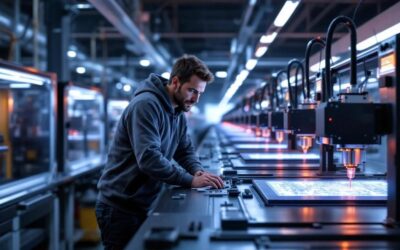
In a plant manufacturing electronic components, a manager noticed an unexplained drop in overall performance. Using TeepTrak’s OEE solution, the team was able to identify that most of the losses were due to often overlooked micro-stops. Thanks to the detailed analysis provided by the tool, steps were taken to automate minor adjustments and optimize the sequence of tasks. This resulted in a 12% improvement in OEE over just three months of implementation.
For plant managers facing these challenges, action starts with structuring a data-driven TRS/OEE project. It’s crucial to favor an approach based on solutions like TeepTrak for real-time monitoring and analysis. This will facilitate the deployment of continuous improvement initiatives and guarantee long-term gains in efficiency and quality. Commitment to accurate OEE tracking is not only a strategic requirement, but also a competitive advantage.
FAQ
Question 1: How does calculating OEE affect production?
Precise calculation of the OEE helps identify major process inefficiencies, linking this indicator directly to production capacity optimization.
Question 2: What methods are effective in improving OEE?
Digitizing the shop floor with tools like TeepTrak and applying Lean principles are proven methods for improving OEE.
Question 3: Why is it important to monitor TRS/OEE in real time?
Monitoring OEE in real time helps to detect inefficiencies early and react promptly, increasing the agility of industrial management.

0 Comments